Operations
Owner statements built by hand: the real cost in hours and errors
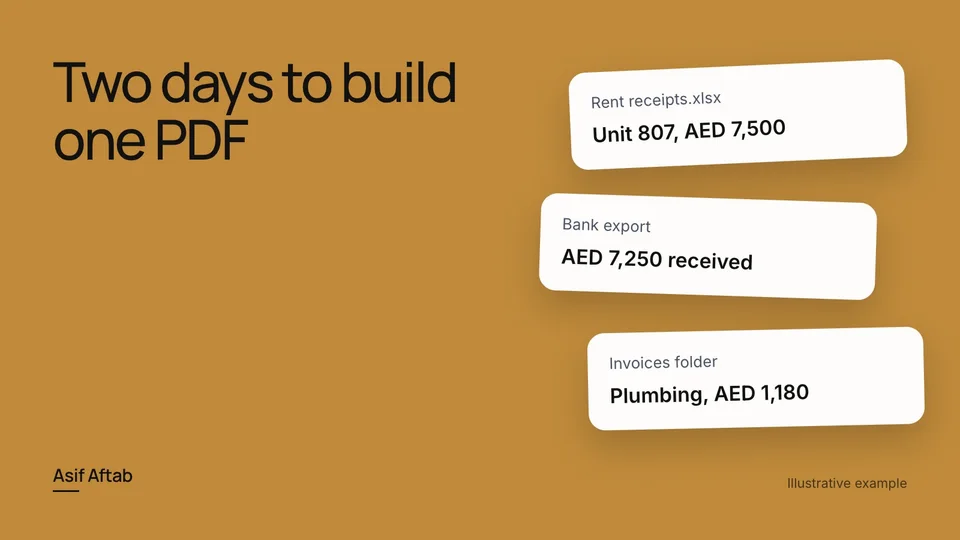
A monthly owner statement built by hand costs more than staff hours. It delays the close, hides errors and leaves nothing to prove the numbers with.

A banker does not start with the headline numbers. A banker starts by asking whether the business can prove them. For a UAE property management firm, that means six checks: bank against ledger, whose money is held, how arrears age, where income is concentrated, who can override a control, and who holds the knowledge.
Every credit assessment begins with the same question. Can this business prove what is happening inside it?
A good set of accounts does not answer that. Neither does a confident owner. A risk officer has seen tidy numbers sit on top of untidy operations. So the question is always about the evidence underneath.
Property management firms rarely apply this test to themselves. They should, because they hold other people’s money and answer to owners, boards and auditors. Here are six things a banker’s eye goes to first.
The six checks at a glance
This is the starting point. If the bank says one thing and the books say another, every other number is in doubt.
The question is not only whether the two agree at month end. It is how long the gap stays open, how large it gets, and who clears it. An old list of unidentified receipts is a warning sign. So is a reconciliation that only one person can explain.
Ask to see last month’s reconciliation. Then look at the oldest item on it. Its age tells you more than the closing balance does.
A property manager’s bank balance can look healthy while very little of it belongs to the firm. Rent collected for owners, deposits and service charge funds may all be sitting there.
A banker wants to know how those funds are identified and kept apart. Can you state, today, how much you hold for each owner? Can you show it without building a spreadsheet first?
If owner money and operating money blur together, a shortfall can stay hidden for a long time. That is the exposure, even if nobody has done anything wrong.
A single arrears total says little. The ageing says a great deal.
Rent overdue by ten days is a collection task. Rent overdue by six months is a different thing, and may no longer be an asset at all. In the UAE, post-dated cheques add another layer. A cheque in the drawer is a promise, not a receipt. A bounced cheque can sit unrecorded for weeks.
Two portfolios with the same arrears total
Look for what has moved between the ageing buckets, not only what sits in them. Then ask whether a returned cheque reaches the arrears report the same day.
Credit analysis always looks for concentration. A firm can seem diversified and still depend on very few relationships.
Count how much of your management fee income comes from your three largest owners or contracts. If one departure would hurt badly, that is a risk worth naming. It also gives you a reason to look at how well that account is served.
A control only counts if it holds under pressure. So a banker asks who can get around it.
Can one person create a vendor, approve the invoice and release the payment? Can a rent amount be changed without a second person seeing it? Are manual overrides recorded, or do they simply happen?
Red flags here tend to look ordinary: duplicate vendors, round-sum payments and manual adjustments near month end. None of these proves a problem. Each one deserves an answer that someone can show. That is why an audit trail matters more than most firms assume.
The last check is about people. If one employee left tomorrow, what would stop working?
In many firms the answer is uncomfortable. One person knows how the owner statements are built. The same person may know which owners get special terms, or where the old files are. That is key-person risk, and a banker treats it as seriously as a financial weakness. The monthly version of this problem appears in owner statements built by hand.
For a banker, due diligence is part of the credit decision rather than a separate exercise. Knowing who you are dealing with, and where the money comes from, is basic risk management.
Real estate has its own reporting rules in the UAE. Licensed real estate brokers and agents must file a Real Estate Activity Report through goAML for specified transactions. This has applied since 1 July 2022. These include certain sales with cash payments of AED 55,000 or more, in a single payment or several. The rule sits in Ministry of Economy Circular 5 of 2022.
Those rules have kept moving, so check the current position with your compliance adviser. The operational point stays the same. A report can only be as good as the records behind it. Identity documents may sit in an inbox and payment details in a separate file. Then the data must be gathered by hand every time. That is slow, and it is where mistakes happen.
So map where each piece of information lives. What would you need to find, and how long would it take?
Sit down with your finance lead and answer the six questions honestly. Do not prepare anything. The point is to see what you can show right now.
| Check | Evidence to produce | Good answer |
|---|---|---|
| Bank and ledger | Last reconciliation | Nothing old and unexplained |
| Whose money | Balance held per owner | Available today |
| Arrears | Ageing report | Runs from live data |
| Concentration | Income by top three clients | Known, and discussed |
| Overrides | List of manual changes | Each has a reason |
| Knowledge | Written process for key tasks | Someone else can do it |
For each one, write down the evidence you could produce today, and how long it would take to find.
Which of the six would you least like an auditor to ask about first?
The Ministry of Economy circular was addressed to licensed real estate brokers and agents, for specified sale transactions. Whether any part applies to your firm depends on your licensed activities. Confirm this with your compliance adviser.
It is a report filed through the goAML platform for specified real estate transactions, such as certain sales involving cash or virtual assets. It came into force on 1 July 2022 under Ministry of Economy Circular 5 of 2022.
As often as money moves. Monthly is a minimum for many firms, but a gap found at month end is already weeks old. Matching receipts as they arrive means problems surface while they are still small.
This is not legal advice. It explains operational impact only. Check the current rules with your adviser and the official sources.
A 20-question self-assessment is in preparation. Leave your email on the newsletter form to hear when it opens.

Real Estate Operations, Risk & Systems Advisor. 20 years in banking risk. Founder, Inovada.
A monthly owner statement built by hand costs more than staff hours. It delays the close, hides errors and leaves nothing to prove the numbers with.
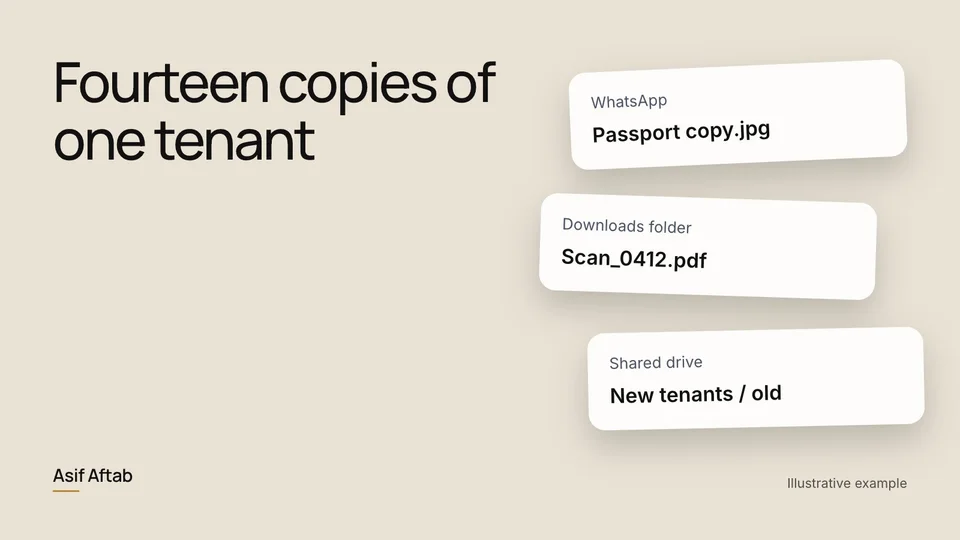
Firms refuse to give a systems partner access to tenant data, yet it already sits in laptops, inboxes and chat groups. Why one controlled system is the safer option.