Risk and Compliance
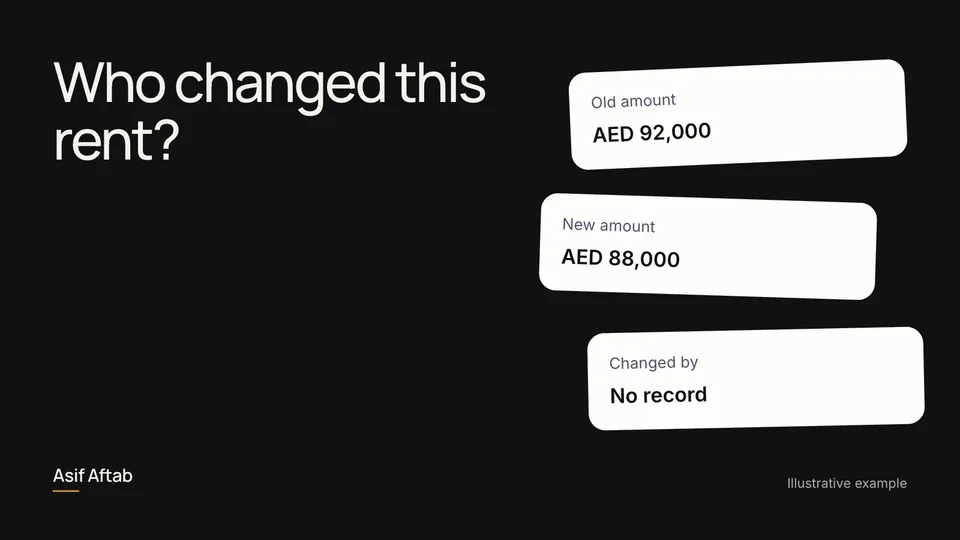
"Who changed this rent amount?" The case for audit trails
An audit trail records who changed what, when and why. Without one, a UAE property firm cannot answer a simple question from an owner or auditor.
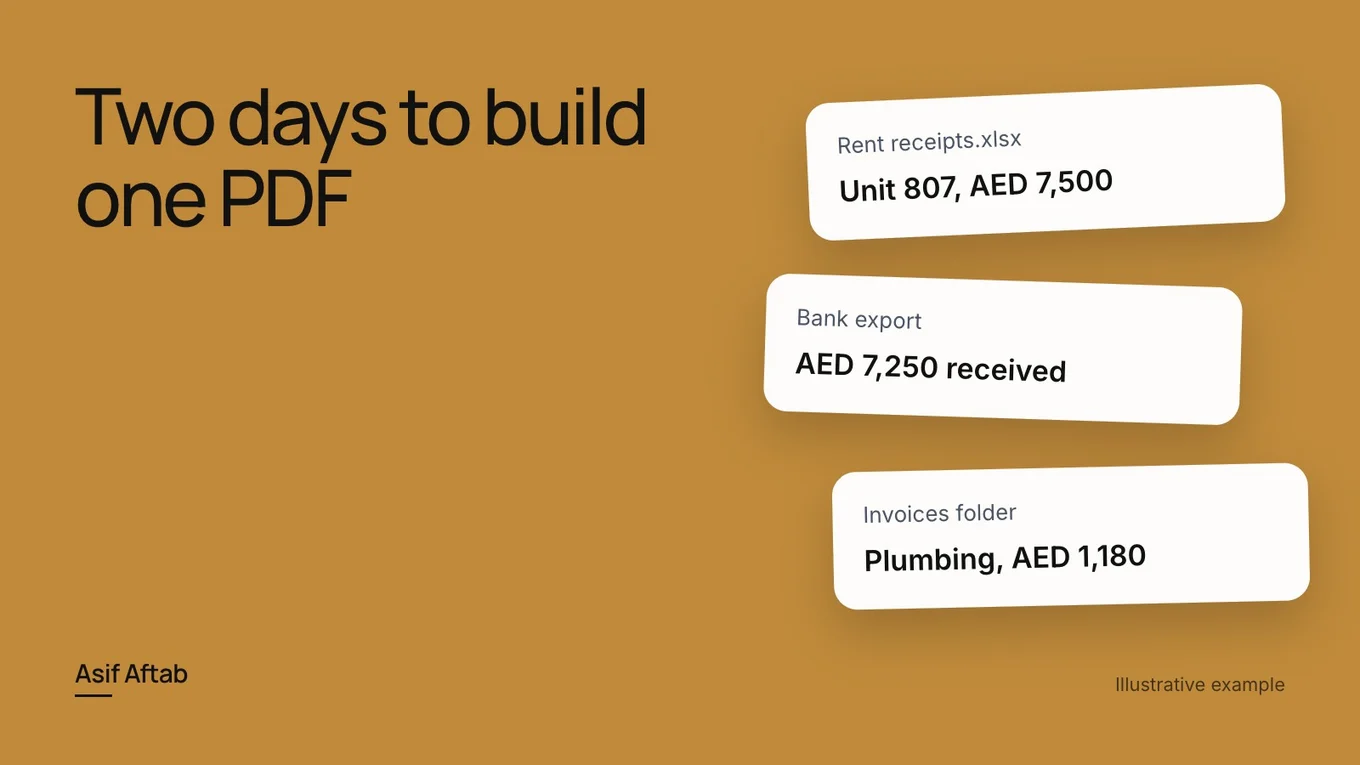
A hand-built owner statement costs a property management firm in three ways: staff hours every month, errors that reach the owner, and a figure nobody can trace back. For a 300-unit portfolio, the hours alone can pass 700 a year. The larger cost is that the firm cannot prove how any number was reached.
Most property managers know how the month ends. Someone exports the bank statement. Someone else opens the rent roll. A third file holds maintenance invoices. Then a capable person spends two days making them agree.
The result looks professional. It goes to the owner as a clean PDF. Nobody sees what it took to produce it, and nobody can check how it was built.
That is the problem with owner statements built by hand. The cost is mostly invisible, so it rarely gets challenged.
Take an illustrative firm. For example: 300 units, 4 people, 2 days to close the month.
The cost of one close, for example
That is 8 person-days, or about 64 hours, every month. Over a year it comes to roughly 768 hours. Those hours belong to the people who know the portfolio best. They fall in the week owners are most likely to call.
Put your own numbers in. Count everyone who touches the statement. Include the person who checks it, and the person who fixes it after a complaint. Most firms have never done this sum. The answer is usually higher than the owner of the business expects.
Hours are the easiest cost to measure, though. They are also the smallest.
A manual statement passes through several hands and several files. Each handover is a chance to introduce an error. These are the ones that tend to appear:
Each error has a cost beyond the correction. The statement must be reissued. Someone has to explain it. The owner now reads next month’s statement more carefully, and starts asking for backup.
| Error | Where it comes from | What the owner sees |
|---|---|---|
| Receipt on the wrong unit | Similar references | Rent missing |
| Returned cheque missed | Bank news arrives late | Rent shown, not received |
| Invoice on the wrong owner | Manual allocation | A charge they do not recognise |
| Fee on rent due | Formula set up once | Fee higher than agreed |
An owner who has found one mistake will assume there are others. That doubt is expensive, and you cannot see it on any report.
The biggest cost is what the firm cannot do. A hand-built statement has no memory.
Ask a simple question three months later: why did this owner receive this amount in March? To answer, someone must find the right version of the file. Then they must find the bank line. Then they must work out which invoices were included and why.
If the person who built it has left, the answer may be gone. Knowledge walks out of the door with them.
This matters more than it first appears. You hold money that belongs to other people. An owner, an auditor or a regulator can reasonably ask you to show how that money moved. “Our accountant checks it” is not the same as being able to show it.
If you want to see why this question matters so much, read what a banker checks first. The same logic applies to any figure edited by hand. That is the subject of the case for audit trails.
If the cost is this high, why do so many firms keep doing it? Three reasons come up repeatedly.
It works, most months. The statement goes out. Owners mostly accept it. There is no crisis to force a decision.
The cost is spread out. Two days here, a reissued statement there, an hour on a difficult call. No single line in the accounts shows the total.
The person is good. Often one experienced employee makes the whole process work. That person is treated as the control. In fact, they are the risk, because the process depends on them being present and careful every month.
A connected operation does not make the statement faster by working harder. It removes the reason for assembling it at all.
Two ways to produce a statement
A lease, a rent charge, a cheque, a bank receipt and an invoice can all belong to one record. The statement is then simply a view of that record. Nobody copies a figure from one file to another. There is no version to lose.
Three things change as a result:
The hours saved are welcome. The real gain is that the firm can stand behind every number it sends.
Pick one owner statement from last month. Pick one figure on it, such as a maintenance charge. Then time how long it takes your team to show the invoice, the approval and the payment.
If it takes under five minutes, your process is in good shape. If someone needs to open four files and ask a colleague, you have found your unmanaged risk.
How long did it take your team, and who was the only person who could do it?
If rent, expenses and bank data sit in one connected record, the statement is a report, not a project. It should take minutes to review. If it takes days to assemble, the time is going into reconciling copies of the same data.
At minimum: rent due and received per unit, arrears, expenses with supporting invoices, management fees, the amount paid to the owner, and the closing balance held for that owner.
For a handful of units with one person in control, it can work. The risk rises with staff turnover, more owners and more people editing the same file. There is no fixed unit count, so watch for the warning signs in this article.
A 20-question self-assessment is in preparation. Leave your email on the newsletter form to hear when it opens.

Real Estate Operations, Risk & Systems Advisor. 20 years in banking risk. Founder, Inovada.
An audit trail records who changed what, when and why. Without one, a UAE property firm cannot answer a simple question from an owner or auditor.
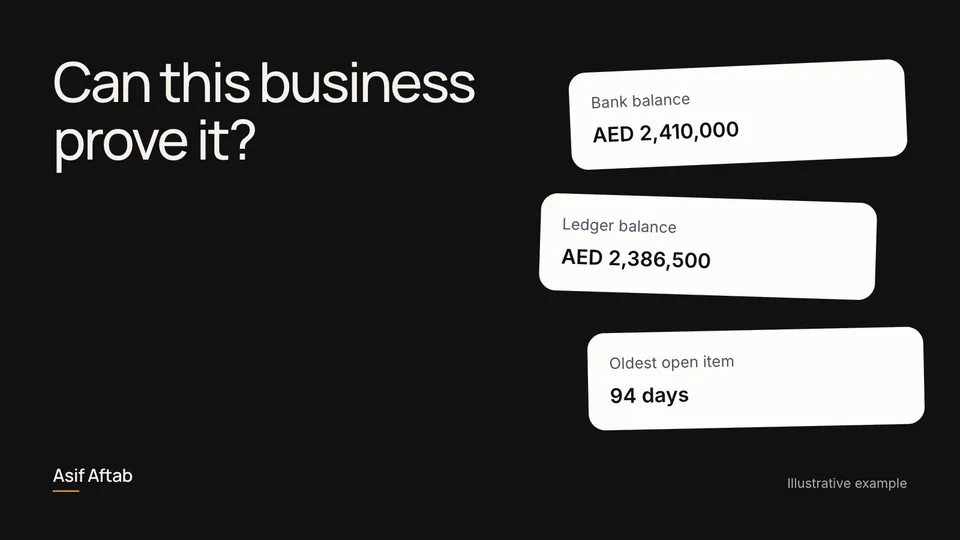
A credit officer starts with one question: can this business prove what is happening inside it? Six checks a UAE property management firm can apply to itself.