Risk and Compliance
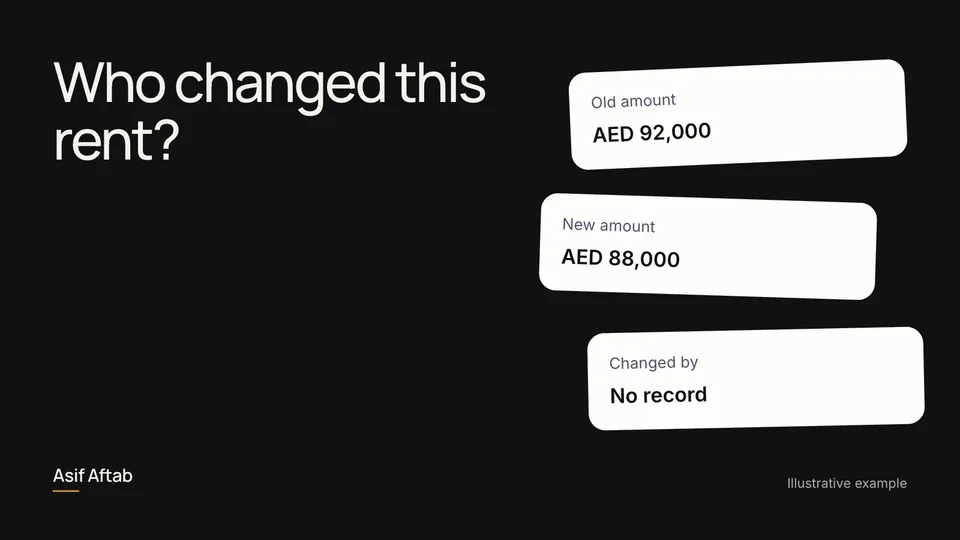
"Who changed this rent amount?" The case for audit trails
An audit trail records who changed what, when and why. Without one, a UAE property firm cannot answer a simple question from an owner or auditor.
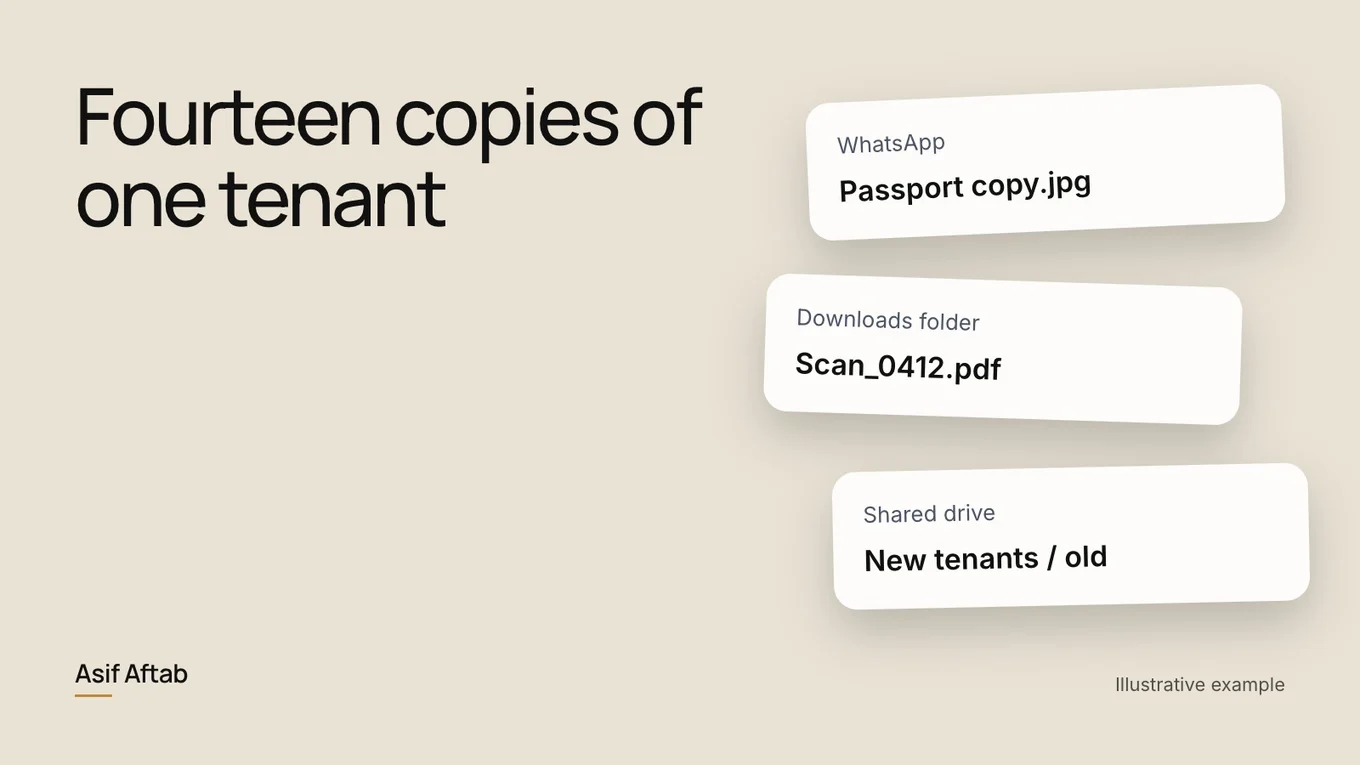
Many property firms resist putting tenant and owner data into a connected system because it feels risky. That same data already sits in spreadsheets, inboxes, laptops and chat groups, with no access control at all. One controlled system is safer than fourteen uncontrolled copies, because you can see who holds the data and remove their access.
Systems discussions often reach the same objection. Tenant data must not go outside the company.
It is a responsible instinct. It is also, in most firms, based on a picture of the business that is not accurate.
Ask where the tenant data is today, and the room usually goes quiet.
Take one tenant in an illustrative firm. For example, follow their passport copy and their Emirates ID from the day they apply.
Where one passport copy ends up
That is seven copies of one person’s identity documents, before anyone has done anything careless. Add the older versions of the rent roll, and an old laptop in a cupboard. Fourteen copies is not an exaggeration. It is a normal Tuesday.
None of these copies has an owner. None has an expiry date. Nobody can list them.
The worry about a system is understandable, because a system is visible. It has a name, a contract and a login page. The risk feels like something you are choosing to take.
The scattered copies feel like nothing at all. Nobody decided to create them. They simply build up, one convenient message at a time.
So firms compare a visible risk with an invisible one, and treat the invisible one as zero. That is the data paradox. They refuse to share data with a partner under contract, while it already moves freely with no controls.
This is the same pattern that makes a spreadsheet feel safe. The familiar option gets a free pass. A banker would ask a harder question, as this article on credit checks shows: what can you prove?
Data control is not about where the server sits. It comes down to four questions you can answer on any day.
| The question | Scattered files | One controlled system |
|---|---|---|
| Where is it? | Nobody can list every copy | One known location |
| Who can see it? | Whoever was copied in | Set by job role |
| Who has seen or changed it? | No record | Logged |
| Can you take it back? | Only partly | Same day |
A firm running on scattered files cannot answer any of these. A firm running one controlled system can answer all four. That difference matters far more than whether the data sits on a machine in your office.
This is where the paradox stops being theoretical. An employee resigns. They have a phone full of tenant documents, a laptop with the rent roll, and years of chat groups.
What can you switch off? Their email, perhaps. The rest stays with them, on devices you do not control, in conversations you cannot see.
Staff turnover is normal in this industry. So the question is not whether this happens, but how often, and what leaves each time.
The UAE has a federal data protection law, Federal Decree-Law No. 45 of 2021. It covers the processing of personal data through electronic systems. It gives individuals rights. These include asking for inaccurate data to be corrected, and for processing to be restricted or stopped. Financial free zones such as DIFC have their own law.
The detail of how and when these rules apply is a matter for your legal adviser. Check the current position, including the status of the executive regulations.
The operational impact is easier to state. If a tenant asks you to correct their details, you need to find them first. That is hard to do across fourteen copies. The same is true of deleting records you no longer need. It also applies if a laptop goes missing and you must work out what was exposed.
You cannot apply a rule to data you cannot find.
Being careful about a partner is still right. Moving data into one system does not remove risk, it changes where you manage it. So ask direct questions:
A good partner will answer these without hesitation. These questions are worth asking. They are also worth asking of your own WhatsApp groups.
Pick one tenant at random. Ask your team to list every place that tenant’s identity documents are held, including phones and old files.
Then ask who could see each copy, and how you would remove it.
If you had to delete that tenant’s documents today, how sure would you be that you found them all?
It feels safer because the files are close by. In practice, spreadsheets are easily copied, emailed and taken away, with no record of who opened them. A controlled system with named users and access rights gives you more visibility.
Federal Decree-Law No. 45 of 2021 is the general federal law. Financial free zones such as DIFC have their own data protection law. Which rules apply depends on where you operate, so confirm this with your legal adviser.
Access should end on their last day, through a defined process. That is only possible if you know where the data is. Files on personal devices and in chat groups are the part you cannot switch off.
This is not legal advice. It explains operational impact only. Check the current rules with your adviser and the official sources.
A 20-question self-assessment is in preparation. Leave your email on the newsletter form to hear when it opens.

Real Estate Operations, Risk & Systems Advisor. 20 years in banking risk. Founder, Inovada.
An audit trail records who changed what, when and why. Without one, a UAE property firm cannot answer a simple question from an owner or auditor.
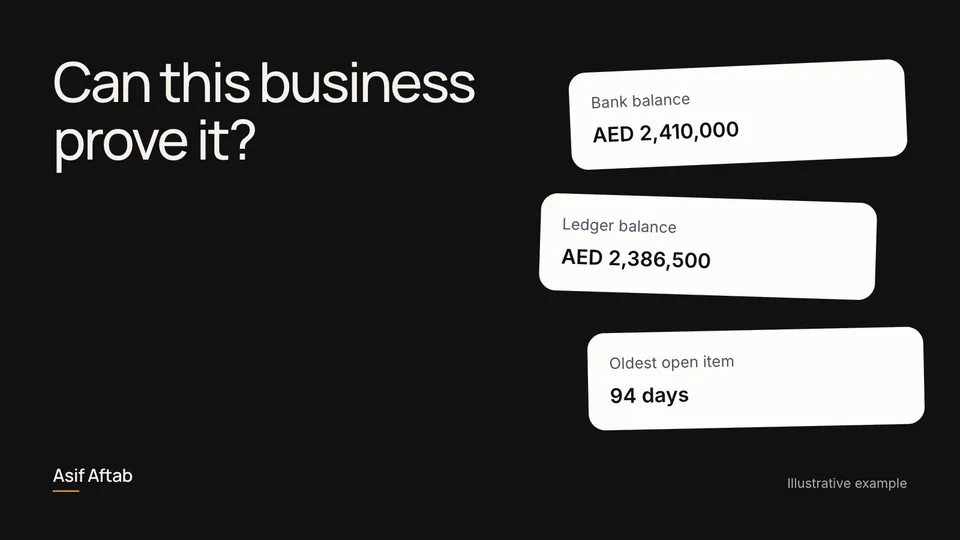
A credit officer starts with one question: can this business prove what is happening inside it? Six checks a UAE property management firm can apply to itself.