Operations
Why cheque and PDC tracking breaks down beyond a few hundred units
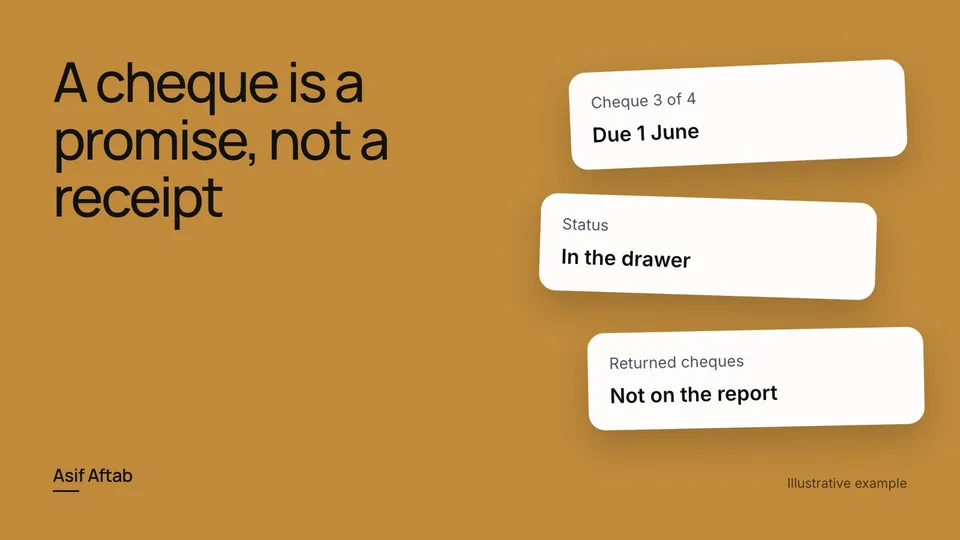
Post-dated cheques work on paper until volume rises. Why spreadsheet tracking fails around a few hundred units, and what a controlled cheque register needs.
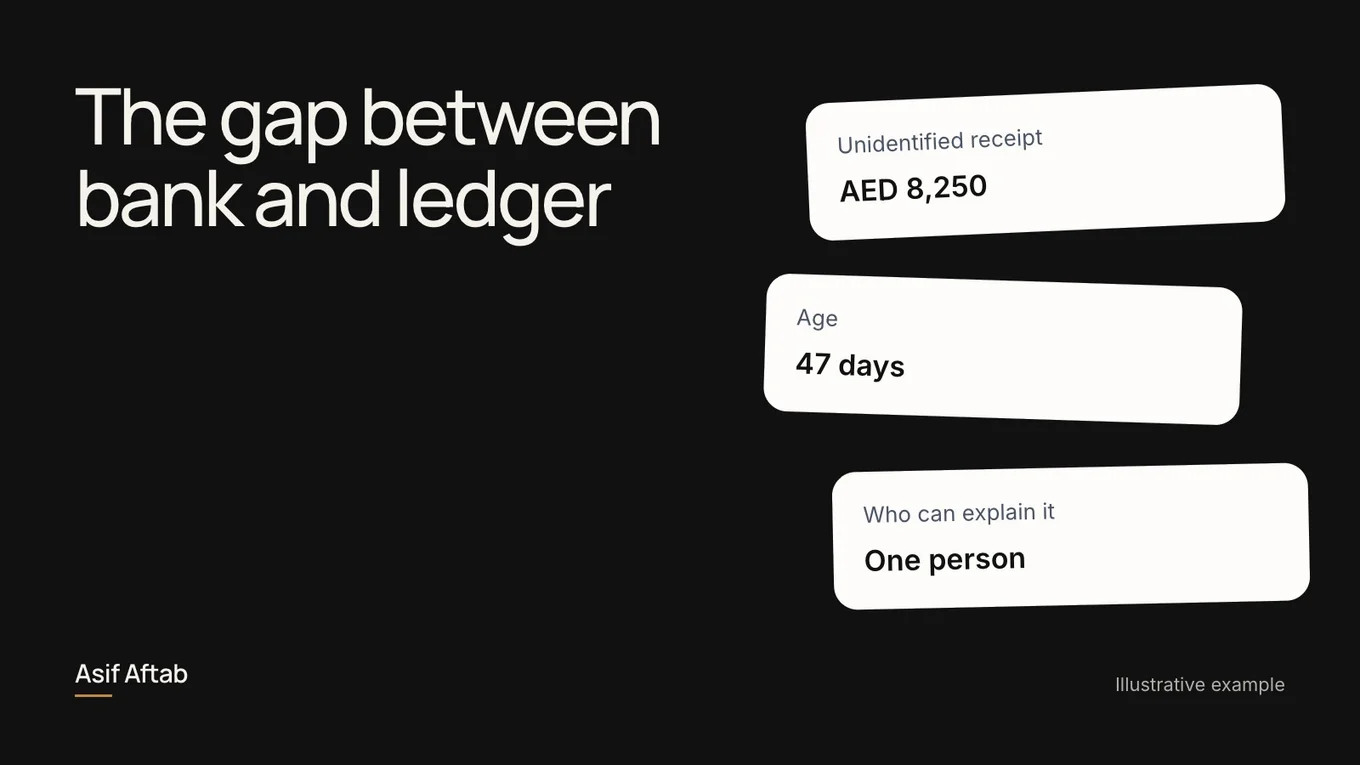
Reconciliation risk is the chance that your bank and your ledger disagree and nobody knows why. In property firms the gap grows through unidentified receipts, returned cheques and timing differences. A reconciliation that balances at month end can still hide old items. The age of those items matters more than the total.
Every month, the reconciliation balances. The finance team signs it off. Everyone moves on.
Look closer, though. At the bottom sits a list of reconciling items. Some have been there since the spring.
A reconciliation does not prove that your numbers are right. It shows the difference between two records and explains it. The quality of that explanation is where the risk sits.
Few businesses handle as many small, separate receipts on behalf of other people.
| Source of the gap | How it happens |
|---|---|
| Vague bank transfers | Tenant pays with no unit reference |
| Cheques in transit | Banked, not yet cleared or recorded |
| Returned cheques | Bank reverses, ledger still shows rent |
| Bank charges | Deducted, and posted weeks later |
| Part payments | One transfer covers several invoices |
| Owner remittances | Paid by hand, recorded in a separate file |
Each item is small on its own. Together they create a fog. Returned cheques are especially harmful, as described in why PDC tracking breaks down.
A finance lead looks at the total difference. A risk officer looks at the age.
A receipt from last week is normal. A receipt from four months ago means someone stopped trying. It is also harder to resolve, because memories fade and staff move on.
Unidentified items by age
Why worry about the smallest bar? Because it is the part that nobody can explain. An auditor will go straight there.
Most old items are harmless. Somewhere in them, though, can sit real problems.
Tenant money that should have reduced arrears means you may be chasing someone who already paid. An owner’s funds might be sitting unallocated. A duplicated payment could be going unnoticed. Occasionally, an item covers a mistake someone preferred not to raise.
You cannot tell which is which until the item is cleared. That is the point. Unexplained is not the same as harmless.
Reconciliation sits at the base of your reporting. If it is late or weak, the rest inherits the doubt.
What a weak reconciliation touches
This is why owner statements take so long. Half the effort is resolving, in a hurry, what should have been resolved as money arrived.
The best control is to shrink the gap between money arriving and money being identified.
Month-end event or daily habit
Two simple rules change a lot. Every unidentified item gets a named owner. Anything older than an agreed age, for example 30 days, goes to a manager.
Unit-specific payment references help too. Ask tenants to quote one, and make it easy. When a transfer identifies itself, most of the work disappears.
Clearing old items feels productive, but they come back if the cause remains. Look at the last twenty unidentified receipts and sort them by reason.
You may find that most come from a few sources. Perhaps one building has no payment reference on its invoices. Perhaps one owner pays contractors directly. Perhaps part payments are not allocated until month end.
Each of those has a simple process fix. Add the reference to the invoice. Agree how direct payments are reported. Allocate part payments on the day they arrive.
A short root-cause review each quarter will do more than another late night at month end.
Reconciliation is often treated as a back-office task. It deserves more senior attention.
A managing director does not need the detail. They do need one short view each month: total unidentified, how much is over 30 days, and how much is over 90. If those numbers rise, something is wrong in the process, whatever the staffing explanation.
Separation matters too. Where possible, the person who reconciles should not also be the person who records receipts.
Open last month’s bank reconciliation. Find the oldest item on it.
Ask who owns it, what it is, and when it will be cleared. Then add up everything older than 30 days.
If an auditor pointed at that oldest line tomorrow, who in your firm could explain it?
Money that reached the bank, but cannot yet be matched to a tenant, owner or invoice. It is common when tenants pay by transfer with a vague reference.
As often as money moves. Many firms reconcile monthly, but daily or weekly matching finds problems while they are small and easy to explain.
You should be able to state what is held for each owner at any time. How accounts are structured depends on your firm and your obligations, so take advice on that point.
A 20-question self-assessment is in preparation. Leave your email on the newsletter form to hear when it opens.

Real Estate Operations, Risk & Systems Advisor. 20 years in banking risk. Founder, Inovada.
Post-dated cheques work on paper until volume rises. Why spreadsheet tracking fails around a few hundred units, and what a controlled cheque register needs.
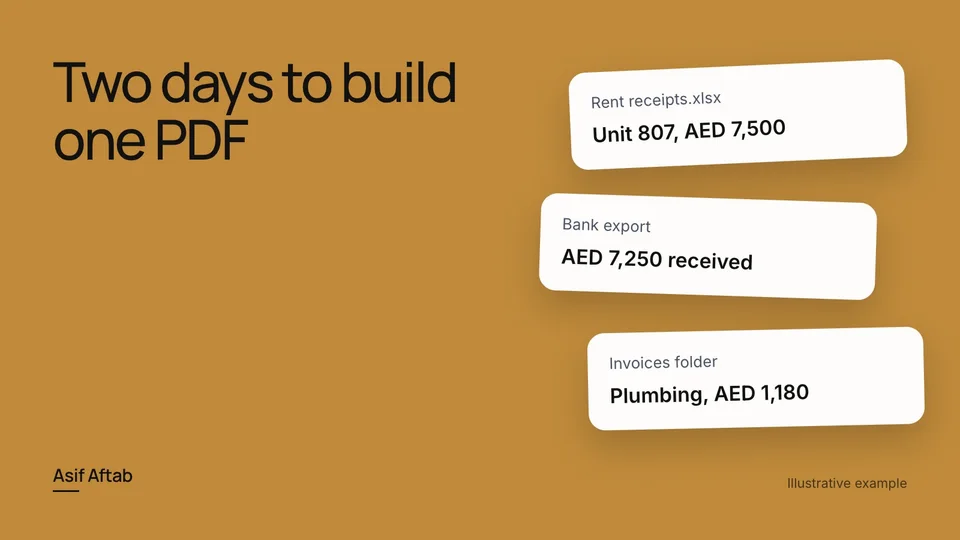
A monthly owner statement built by hand costs more than staff hours. It delays the close, hides errors and leaves nothing to prove the numbers with.