Risk and Compliance
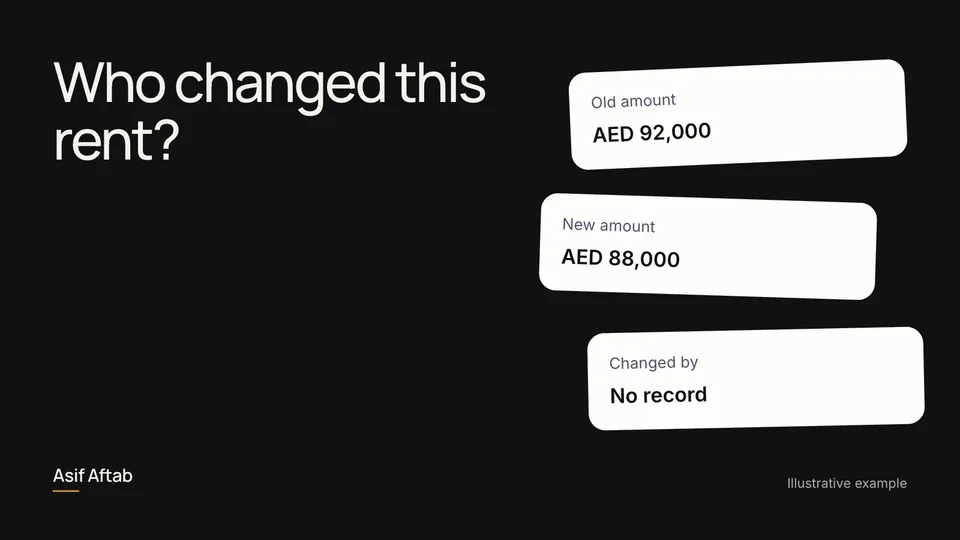
"Who changed this rent amount?" The case for audit trails
An audit trail records who changed what, when and why. Without one, a UAE property firm cannot answer a simple question from an owner or auditor.
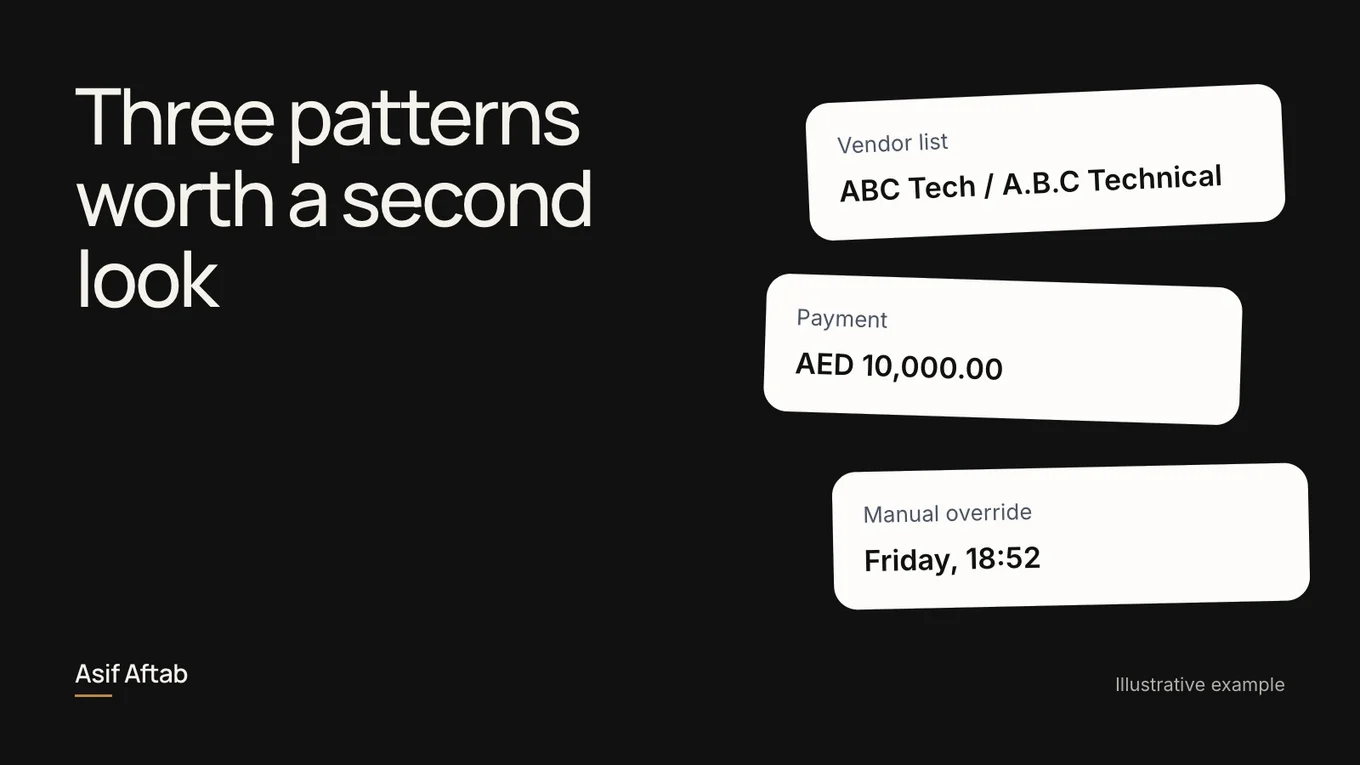
Three patterns deserve a second look in any property firm: duplicate vendors, round-sum payments and manual overrides. None of them proves wrongdoing, and most have innocent causes. But each is also how errors and misuse hide. A well-run firm can review them routinely and show a reason for each one.
A risk officer rarely finds trouble by reading the accounts. They find it by looking at patterns that do not quite fit.
Three of those patterns turn up in property operations again and again. None of them proves anything. Most have dull, innocent explanations.
That is what makes them useful. A firm with good controls can show the reason in minutes. A firm without them has to go and investigate.
Let us be clear about tone. This is about practices, not people. Honest staff benefit most from these checks, because they can clear their name instantly.
The same supplier appears twice, with a slight difference in the name. For example, “ABC Tech” and “A.B.C Technical Services”.
Usually, this is untidy data. Someone added a supplier without searching first. But duplicates also make it possible to pay one invoice twice. They are also how a false supplier can hide in a long list.
The strongest signal is shared details. Two vendor names with one bank account deserve a question.
Real invoices are rarely neat. Materials, labour and VAT usually produce an awkward figure.
So a run of payments at exactly AED 10,000 or AED 5,000 stands out. It can mean an estimate paid without an invoice, or an advance never settled. Payments sitting just below an approval limit deserve the same attention.
For example, say approval is needed at AED 10,000. Look at how many payments fall between AED 9,500 and AED 9,999.
A system says no, and someone makes it say yes. A rent is adjusted. An invoice is reopened. A write-off posted late on a Friday.
Overrides are normal. Business needs them. The risk lies in overrides with no reason, no second person and no trail. That is why an audit trail is the foundation for this whole review.
| Pattern | Common innocent cause | What could sit behind it | The check |
|---|---|---|---|
| Duplicate vendor | Added twice by mistake | Double payment, false supplier | Compare names, bank details, addresses |
| Round-sum payment | Agreed fixed fee | Payment with no invoice | Match to contract or invoice |
| Just under the limit | Standard job price | Splitting to avoid approval | Look for repeats by vendor and person |
| Manual override | Genuine correction | Unapproved change | Look for reason and second approver |
| Late posting | Month-end pressure | Numbers adjusted to fit | Review entries posted after close |
Notice the second column. Starting from the innocent cause keeps the review fair, and it keeps staff on side.
These patterns are most useful when combined. One round payment means little. A round payment to a new vendor, approved by the person who created it, means more.
Why separation of duties matters
Small firms often cannot separate every duty. That is fine. An owner reviewing a short exception list each month covers much of the same risk. This is exactly the question a banker asks in what a banker checks first: who can get around a control?
You do not need a forensic team. You need a list and a habit.
Monthly exception list
Bank detail changes deserve special attention. Payment fraud often starts with one convincing email asking to update an account. Always confirm through a known phone number, never the one in the email.
If your data is scattered, this list takes days and rarely gets done. In a connected system, it is a saved report. The difference decides whether the review happens at all.
Tell the team why you are doing it. Explain that it protects them. Share the list, and treat each item as a question, not an accusation.
Most exceptions will clear in a sentence. That is a good result. It means your controls are working, and you can prove it.
Export your vendor list and sort it by bank account number. Then look for any account that appears twice.
Next, count last month’s payments at exact round amounts. Pick three, and find the document behind each.
Which of those three patterns would take your team longest to explain?
No. A red flag is a prompt to check, not a finding. Most have ordinary explanations. The control is being able to show that explanation quickly.
Monthly is a reasonable starting point for most firms. The review can be short if your system can list the exceptions automatically.
Someone independent of the transaction. In a small firm, that may be an owner or director looking at a short exception list, rather than the person who processed it.
A 20-question self-assessment is in preparation. Leave your email on the newsletter form to hear when it opens.

Real Estate Operations, Risk & Systems Advisor. 20 years in banking risk. Founder, Inovada.
An audit trail records who changed what, when and why. Without one, a UAE property firm cannot answer a simple question from an owner or auditor.

A credit officer starts with one question: can this business prove what is happening inside it? Six checks a UAE property management firm can apply to itself.